The Midnight QSO
The old wooden desk in the corner of the basement smelled of solder and coffee. Randy, callsign K9XXX, sat hunched over his rig at 1:17 a.m., the only light coming from the glow of two computer monitors and the soft orange standby LED on his Icom IC-7300 HF transceiver. At seventy-one, most of his friends had long since given up on the hobby, but Hank still chased DX—until tonight, when the old ways met the new.
He had spent the last three weeks integrating a Raspberry Pi 5 running the latest WSJT-X software (version 2.7+) alongside his transceiver. The Pi handled all audio I/O through a simple USB sound card interface, with CAT control over USB for automatic frequency and PTT management. No more clunky hardware TNCs like the old days of packet radio.
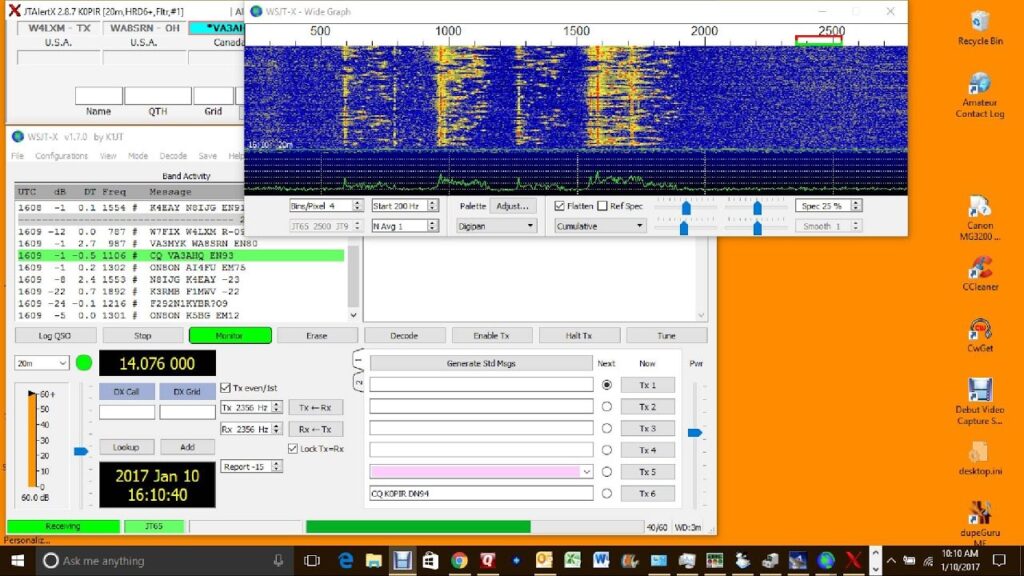
On the main screen, WSJT-X displayed a vibrant waterfall. The 20-meter band looked quiet to the human ear—just faint hiss—but the spectrogram told a different story. Thin green lines danced across a 2.5 kHz slice of spectrum, each representing digital signals using advanced forward error correction (FEC) to survive propagation that would swallow voice or even CW.
Randy wasn’t interested in casual ragchewing tonight. He had his eye on a rare one: 3D2CR on Conway Reef. The station had been spotted earlier via the PSK Reporter network, which automatically uploads decoded signals from stations worldwide.
He tuned to the FT8 watering hole around 14.074 MHz. FT8—Franke-Taylor 8-FSK—had been released in 2017 by Nobel laureate Joe Taylor, K1JT, and Steve Franke, K9AN. It used 8-tone frequency-shift keying with tones spaced just 6.25 Hz apart, occupying only about 50 Hz of bandwidth per signal. Each transmission lasted 12.64 seconds within a strict 15-second cycle (leaving 2.36 seconds for decoding), sending 79 symbols at a keying rate synced to the computer’s clock (Hank used Dimension 4 for NTP synchronization accurate to milliseconds).
The protocol packed a 77-bit message (plus CRC) using low-density parity-check (LDPC) coding—specifically an LDPC(174,91) code—for robust error correction. This allowed reliable decoding even at signal-to-noise ratios as low as -21 dB in a 2500 Hz bandwidth, far below what the human ear could detect (CW typically needs around -15 dB, SSB +10 dB or more). Each message carried essential data: callsigns, 4- or 6-character Maidenhead grid locator, and signal reports in dB. Effective throughput was roughly 5 words per minute—slow for conversation, but perfect for DXing under marginal conditions.
Randy double-clicked the 3D2CR callsign that popped up. His software automatically generated the standard exchange sequence and keyed the radio via the Pi’s GPIO-controlled PTT.
The tones began: a continuous-phase, constant-envelope waveform with three 7×7 Costas arrays embedded for synchronization (at the start, middle, and end of the transmission). The radio output a clean 50 watts into his modest inverted-V antenna.
Seventy-five seconds later (after one full cycle and decode), the reply appeared instantly on screen:
3D2CR: W4ECHO -07
Even though the signal was buried 15–18 dB below the noise floor, the LDPC decoder and a priori (AP) decoding pulled it through perfectly. No static, no missed dits—pure digital extraction.
Randy sent his report back. The automated ballet continued:
W4ECHO: 3D2CR R-07 3D2CR: W4ECHO RR73 W4ECHO: 3D2CR 73 GL
Contact complete in under four minutes. WSJT-X logged it automatically with timestamp, frequency, mode, and SNR data, then uploaded it via the internet to Logbook of The World (LoTW) and Club Log for DXCC credit. Within minutes, the QSO would appear on DX clusters and be confirmed by other stations monitoring the same frequency.
Randy leaned back, sipping cold coffee. He thought about the evolution that had brought him here.
It started decades ago with RTTY—radio teletype using 5-bit Baudot code and frequency-shift keying (FSK), first with mechanical teleprinters clacking away at 60 words per minute, later emulated in software. Then came packet radio in the 1980s: AX.25 protocol at 1200 baud on VHF, with digipeaters and bulletin board systems (BBS). HF brought PACTOR and its successors for reliable ARQ (automatic repeat request) error correction, used heavily in emergency messaging.
The “sound card modes” revolution arrived with PSK31 (phase-shift keying at 31.25 baud, invented by Peter Martinez, G3PLX) for narrow, keyboard-to-keyboard chats. Then Joe Taylor’s WSJT suite introduced JT65 and JT9 for extreme weak-signal work—slow but incredibly sensitive, using 65-tone or 9-tone FSK with Reed-Solomon or LDPC coding.
FT8 was the game-changer: faster than JT65 (15-second cycles vs. 60+ seconds) while still decoding down to -20 dB or better. Its structured exchanges sacrificed ragchewing for efficiency—ideal for pileups and fading bands. Newer variants like FT4 offered even quicker 7.5-second cycles for contests, while modes like JS8Call added text messaging and relay capabilities for true conversations or emergency nets. Olivia and MFSK provided multi-tone resilience against multipath and interference.
Randy’s setup was simple yet powerful: the transceiver’s built-in sound card interface fed audio directly to the Pi, where fast Fourier transform (FFT) analysis turned received tones into decodable symbols. Transmit audio went back the other way. No more tuning by ear or watching a tuning indicator—everything was visual and automated.
A new CQ appeared on the waterfall: VK0AI, Macquarie Island. Another all-time new one (ATNO) for Hank.
He adjusted the audio levels slightly, ensured his transmit frequency was clear of other QSOs (FT8 etiquette demanded staying in the 50 Hz “slot” assigned by the software), and clicked “Enable TX.”
The precise tones began again—eight carefully spaced frequencies, carrying three bits per symbol, synchronized globally so stations didn’t step on each other.
Somewhere in the Southern Ocean, another operator’s computer—perhaps running the same WSJT-X on a similar setup—was listening through the same invisible ocean of noise, its LDPC decoder patiently extracting bits from the ether.
In the quiet basement in Virginia, Hank smiled into the glow of the screen.
“Still talking to the world,” he whispered. “Just speaking a much more efficient language now—one built on mathematics, error-correcting codes, and a shared understanding of propagation physics.”
The digital conversation continued, long after most voice and CW operators had gone to bed. The band might sound dead, but to those who knew how to listen with silicon and software, it was alive with signals from every corner of the planet.
This version adds concrete technical depth—modulation details, SNR thresholds, protocol specs, coding methods, cycle timing, historical progression, and integration with modern tools—without turning the story into a textbook. Let me know if you’d like even more specifics on a particular mode (e.g., expanding on JS8Call for messaging, VARA for higher-speed data, or Q65 for moonbounce), a different focus (emergency comms, contesting), or further adjustments to the narrative!