Long before the digital age, amateur radio lived in the roar of amplitude modulation—AM—where full-carrier signals with two sidebands consumed precious spectrum like a loud, inefficient conversation in a crowded room. A 100-watt AM phone signal spread across 6–10 kHz, wasting power and inviting interference. Then came a quieter, sharper revolution: Single Sideband (SSB). It would transform voice communication on the HF bands, doubling effective power, slashing bandwidth in half, and letting hams reach farther with less.
The concept of SSB wasn’t born in a ham shack. Its roots traced back to 1915, when engineer John Renshaw Carson at Bell Labs mathematically described suppressing one sideband and the carrier to send voice more efficiently. Commercial transatlantic telephone service used early SSB on longwave in 1927. Military and telephone engineers refined it through the 1930s and World War II. But for radio amateurs—tinkerers with limited budgets and surplus gear—the technology seemed exotic and complex until the postwar years.
The spark in amateur radio ignited on September 21, 1947. At Stanford University’s club station W6YX, Oswald G. Villard Jr., W6QYT (later W6QIT), fired up an experimental single-sideband transmitter on the 75-meter band. He made the first documented amateur SSB contact with W6VQD. Just weeks later, on October 9, W6YX opened the 20-meter band with another SSB QSO. Word spread fast. Within days, Art Nichols, W0TQK, hastily built his own rig and worked Villard while dozens of curious hams listened in amazement—copying the strange, narrow signal on ordinary receivers by reinserting the carrier in their minds or with simple BFO tweaks.
Early SSB was not easy. Hams built gear using the filter method (sharp crystal or mechanical filters to strip away one sideband and carrier) or the phasing method (two balanced modulators with audio and RF phase shifts to cancel the unwanted sideband). Articles in QST and magazines like R9 described homebrew exciters. Don Norgaard, W6KUJ (sometimes listed as W2KUJ in early contexts), and others published practical designs. In 1948, Stanford’s experiments gained attention, and by the early 1950s, pioneering manufacturers stepped in. Central Electronics, founded by Wes Schum, W9DYV, released the Model 10A in 1952—the first commercial SSB exciter aimed squarely at amateurs. It was followed by the 20A. These units let hams add SSB capability to their existing AM transmitters.
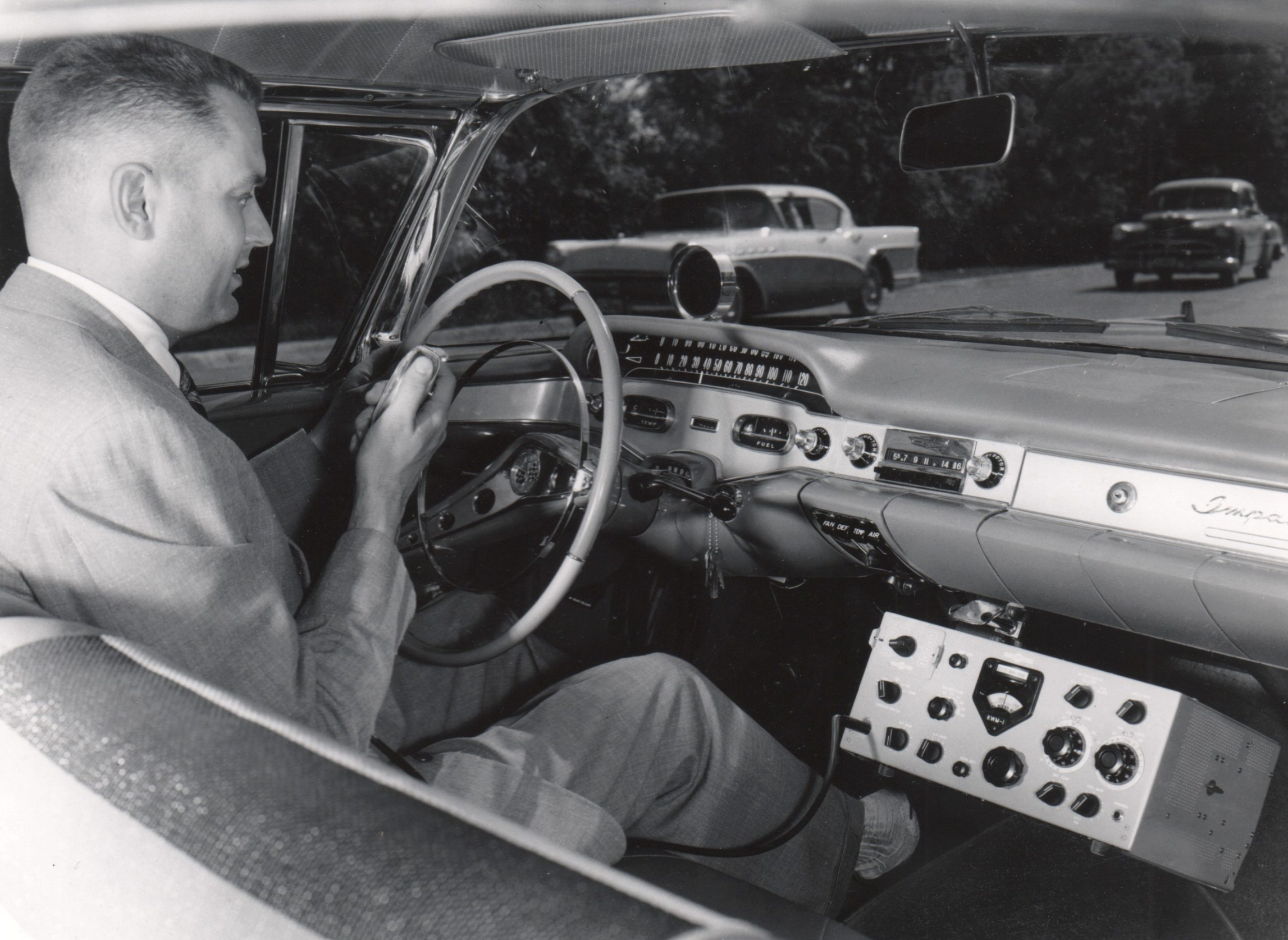
The real tipping point came from Collins Radio. Arthur Collins, W0CXX, and his team had already perfected mechanical filters that made stable, high-quality SSB practical. In late 1954, Collins ran a series of influential “Engineering Notes” in QST explaining SSB’s advantages. Then, in May 1957, they released the groundbreaking KWM-1—the first SSB transceiver, and the first truly mobile HF transceiver. Compact, reliable, and capable of 100 watts PEP (peak envelope power), the KWM-1 changed everything. No more separate transmitter and receiver; hams could now operate SSB from a car, boat, or remote location with ease. Collins’ influence extended even to the military: their demonstrations helped convince the Strategic Air Command to adopt SSB for B-52 bombers in 1957.
Throughout the 1950s, SSB sparked lively debate—“Signal Wars,” some called it. Traditional AM operators complained that SSB sounded “Donald Duck-ish” without proper carrier reinsertion, or that it was too finicky to tune. Old-timers clung to their plate-modulated rigs, enjoying the warm, full sound of AM. But the advantages were undeniable: an SSB signal used roughly half the bandwidth, concentrated all the power into one sideband, and delivered roughly 6–9 dB more effective “talk power” than an equivalent AM signal. In crowded DX pile-ups or during poor propagation, SSB punched through where AM faded. By the late 1950s, commercial rigs proliferated—Heathkit, Hallicrafters, Drake, and others offered affordable options or kits. The ARRL published its first “Single Sideband for the Radio Amateur” handbook in 1954, guiding thousands through the transition.
By the mid-1960s, the shift was nearly complete on HF phone bands. What had been mostly AM in 1959 became overwhelmingly SSB by 1965. Ragchewers discovered natural-sounding conversations with less splatter. DXers worked more stations in less time. Contests exploded in activity. Even mobile and maritime operators embraced SSB for its efficiency. In Britain, the KW Viceroy became a popular early SSB transmitter. Across the world, hams adapted linear amplifiers (often Class AB1 tetrodes) to boost their SSB signals cleanly.
Today, nearly 70 years after Villard’s pioneering QSO, SSB remains the dominant voice mode for long-distance HF amateur communication. It survived the rise of digital modes like FT8 because nothing quite replaces the warmth of a human voice carried on a single sideband. Modern transceivers offer built-in SSB with DSP filtering, noise reduction, and automatic tuning—luxuries the 1947 experimenters could scarcely imagine. Yet the core principle endures: suppress the carrier and one sideband, focus every watt of power where it counts, and let your voice fly farther across the ionosphere.
The old AM operators who once grumbled about “those sidebanders” would scarcely recognize today’s bands. But many eventually joined the migration, discovering that sometimes the future sounds clearest when you remove everything unnecessary—leaving just the essential voice, riding one wing of the wave.
73 to the SSB pioneers who taught amateur radio how to speak more efficiently—and how to listen harder.