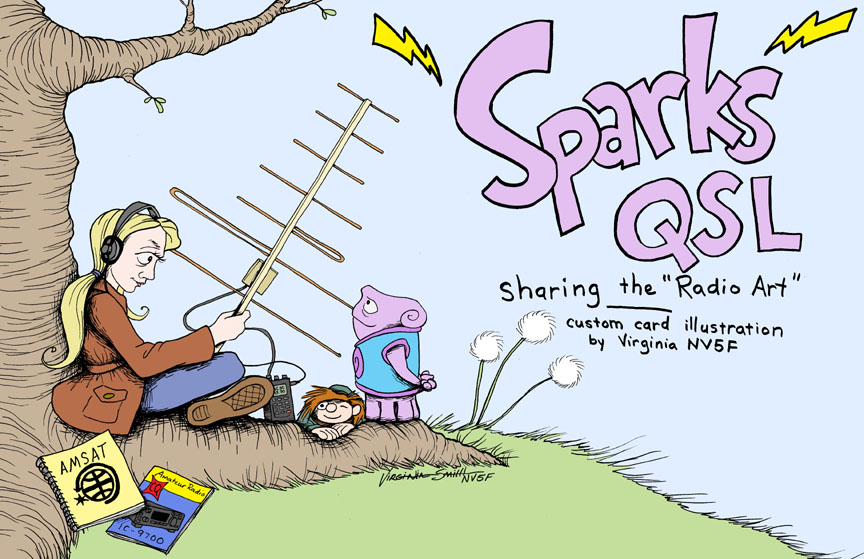
Echoes from the Void
In the quiet suburbs of Boulder, Colorado, 14-year-old Alex Chen spent most evenings in the basement, surrounded by soldering irons, old computer fans, and a forest of antennas sprouting from the roof like mechanical wildflowers. His call sign was KC7SAT — a name he chose with teenage pride because he dreamed of talking to satellites.
Alex wasn’t just any teenager with a hobby. He was part of a global network of amateur radio operators who tracked and communicated with low-Earth orbit satellites built by universities, space agencies, and even other kids like him. The satellites were small — CubeSats the size of a loaf of bread — but they carried tiny transponders that let hams around the world exchange signals as the satellites raced overhead at 17,000 miles per hour.
One crisp October evening, Alex aimed his homemade Yagi antenna at the predicted path of AO-91, an old AMSAT satellite that had been circling Earth since 2017. He keyed his microphone.
“CQ CQ, this is KC7SAT calling through AO-91. Anyone out there?”
Static hissed, then a clear voice broke through with a slight Japanese accent.
“KC7SAT, this is JA1XYZ in Osaka. You’re coming in 5 by 9! How copy?”
Alex’s heart raced. For ten precious minutes as the satellite passed over the Pacific, he chatted with the Japanese ham about school, antennas, and the aurora that had lit up the sky the night before. Then the signal faded as AO-91 dipped below the horizon.
That night, while most kids his age were scrolling on their phones, Alex stayed up late calculating the next pass of a new satellite: Fox-1Cliff, recently launched by AMSAT. But something felt different. The satellite’s telemetry was acting strangely — its battery voltage was dropping faster than expected, and the temperature readings were erratic.
Alex posted his observations on the AMSAT mailing list. Within hours, responses poured in from operators in Germany, Brazil, South Africa, and New Zealand. They confirmed the anomaly. The little satellite was in trouble.
For the next three days, the worldwide amateur radio community worked like an invisible rescue team. They collected telemetry data every time the satellite came into range of someone’s station. A retired engineer in Australia analyzed the power system. A university student in India wrote a small script to model the thermal behavior. Alex coordinated the data collection from North America, staying up through school nights, his eyes glued to his tracking software.
On the fourth night, during a long pass over the southern hemisphere, a ham in Chile made contact with the satellite’s command receiver. Using a carefully calculated sequence of tones, the international team uploaded a software patch that rebooted the power management system and adjusted the solar panel orientation.
The satellite responded.
Telemetry began streaming normally again. Cheers erupted in living rooms and shacks across six continents as the little CubeSat’s heartbeat stabilized.
Alex leaned back in his chair, exhausted but grinning. For a few minutes, he had been part of something bigger than himself — a global village of ordinary people using simple radios to keep a tiny piece of human ingenuity alive in space.
Years passed.
Alex grew up. He studied aerospace engineering, earned his degree, and eventually joined a small team at a private space company building the next generation of small satellites. But he never abandoned his amateur radio roots. Every satellite his team launched carried an AMSAT transponder — a promise that anyone with a handheld radio and a homemade antenna could still talk to space.
One clear summer night in 2041, Dr. Alex Chen stood on the launch viewing area in Florida as a Falcon Heavy roared into the sky carrying a swarm of CubeSats. Among them was his personal project: a tiny satellite he had helped design and name himself.
Its call sign? KC7SAT-2.
As the rocket’s plume faded into the stars, Alex pulled out an old, battered handheld transceiver from his jacket pocket — the same one he had used as a teenager. He raised the antenna toward the eastern horizon where the new satellite would soon appear on its first orbit.
He keyed the mic one more time.
“CQ from KC7SAT… this is Earth calling KC7SAT-2. How do you read me up there, old friend?”
A faint but clear tone came back almost immediately — the satellite’s automated beacon acknowledging the call.
In that moment, Alex realized the beautiful truth: humanity’s exploration of space wasn’t only being carried out by billion-dollar agencies and sleek corporate rockets. It was also being carried forward, one faint radio signal at a time, by dreamers with soldering irons, rooftops full of antennas, and hearts that refused to accept the sky as a limit.
The stars above seemed just a little closer.
And somewhere high above the Pacific, a small satellite with an amateur radio heart continued its silent, tireless journey — listening, responding, and reminding everyone who tuned in that we are all just travelers sharing the same small planet, reaching out across the void with nothing more powerful than our voices and our curiosity.
73,
KC7SAT (and Grok)